
I've been using SAMRO for years. I also have a joint membership arrangement with PRS in the UK. And the reason I'm writing about this is because when people talk about royalties, there's an awful lot of attention given to registering with an organisation and considerably less attention given to what happens after that, when you're actually trying to find out where the money is coming from.
There's a difference between seeing a payment, seeing a statement, and being able to properly interrogate that statement. Those are not necessarily the same thing. Once your catalogue starts moving between television, online platforms, music libraries and different countries, it gets a little bit more complicated.
I'm not writing this as somebody who tested two demo accounts for a day. This is from administering my own music, speaking to publishers, working through cue sheets and reading the royalty statements that have come back. I've put extracts from my actual statements into this article. No invented figures. The PRS excerpts are from October and December 2025; the SAMRO foreign excerpts are from February and September 2026. Please don't combine them into one imaginary accounting period.
First, the actual arrangement I have with SAMRO and PRS.
I started with SAMRO. The conventional route for foreign performance royalties is that music gets used in another territory, the relevant society there accounts for what it has collected, and the money can make its way back through reciprocal society relationships. So a South African composer can be paid foreign royalties through SAMRO. It is not necessary to join another society just because one of your tracks plays in another country. SAMRO itself explains that its international partners administer music on behalf of members abroad.
What I did later was move the overseas part of my performing-rights representation to PRS, with SAMRO continuing to represent me for the South African territory. That's the joint arrangement. In my older conversation about sync, I said PRS are basically on the prowl, trying to find where my music is being used around the world. That was the way I described what I wanted from that relationship. It isn't a literal guarantee that every broadcast or missing cue sheet will automatically be found.
Part of why I made the change was that I wasn't especially happy with aspects of the international collection experience I was having through SAMRO. I wanted another way of handling that work, and more visibility around the money arriving from different countries. That's my own decision based on my catalogue. I'm not suggesting every South African producer should run off and join PRS tomorrow.
What I get when I open PRS: I can start with the songs rather than just the payment.
PRS calls it My Statements. Its online documentation says I can look at a distribution, click through the works, usages and territories, download the statement, and use its Analytics tools to explore what's happening with the repertoire. My Works is a separate place to review registered compositions. So there are different entry points depending on what I'm trying to investigate.
And this is where the statement itself becomes quite interesting. Here is a small piece of my October 2025 distribution. I'm deliberately not showing the personal header, just the table that matters.
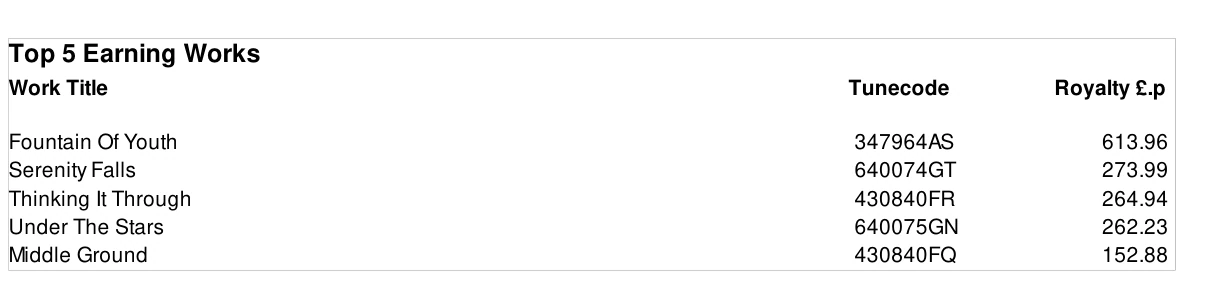
Fountain of Youth is at the top with £613.96. Under that are Serenity Falls, Thinking It Through, Under The Stars and Middle Ground. Already I know which five compositions contributed most to that particular payment. If I'm planning what sort of music to make or which publishing relationships are working, that's information I can use.
Now move a couple of months forward. Same composition, different distribution:
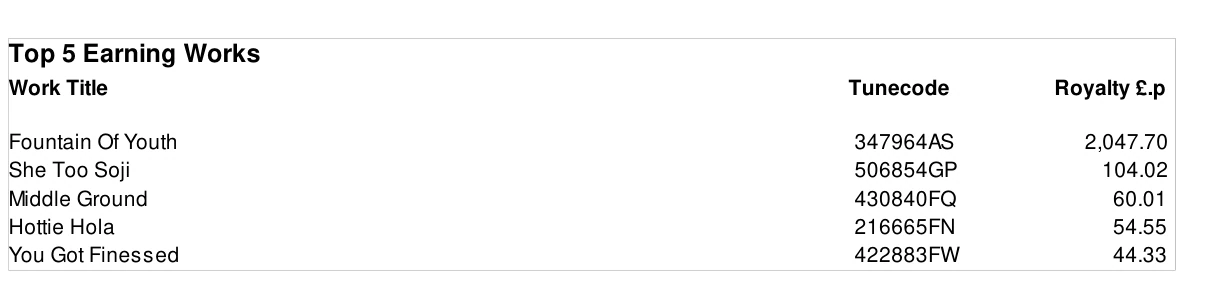
In December 2025, Fountain of Youth is listed at £2,047.70. That's not me saying that a track always earns that amount, or that I've cracked some royalty formula. The same song might have a very different reporting mix and value from one distribution to the next. But this is exactly why I look at the titles instead of seeing £2,500 or £3,000 and moving on.
The next thing I want to know is where the money came from. With the PRS statement I can see usage descriptions that go beyond a single label saying “foreign”. For instance, here's a section of the October 2025 usage summary.

There are separate lines for CNN (NSPD), CNN (SPD) and a CNN–KODA entry covering Denmark. That's a good example of why a television placement isn't always one neat number. Rights, reporting routes and territories create multiple entries. It doesn't mean each line is necessarily a separate programme or a separate licence. You have to drill down into the work detail before making that claim.
December produces another set of CNN entries, including Norway-related reporting and CNN International through STIM in Sweden:

My track Fountain of Youth was used on CNN Inside Africa, and CNN has been a substantial part of what that composition has generated over its lifetime. The numbers in these cropped usage tables are wider than just one track, though. If I want to assign an amount to a particular composition, I have to reconcile the work-detail pages, not guess from the broadcaster name.
The SAMRO statement looks quite different, particularly when foreign money comes in.
Now let me show you what SAMRO sends me. It's still useful information. It is absolutely useful information. But it's organised differently. In the foreign statement, one of the first things I see is a list of the societies that have reported money and the amount allocated in rand. Then further down I get compositions, source descriptions, usages, my share and amounts.
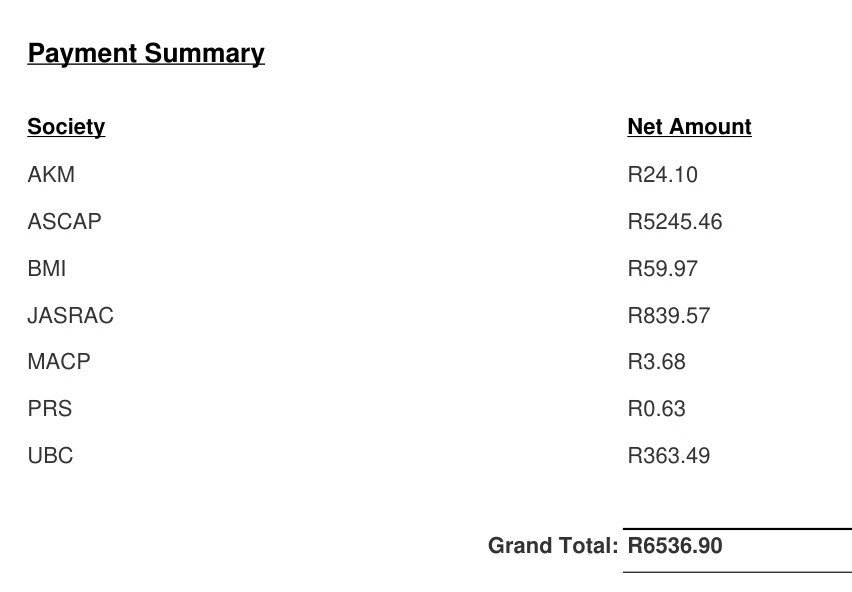
In February 2026 my foreign distribution was R6,536.90. The ASCAP component was R5,245.46; JASRAC contributed R839.57, with smaller amounts from BMI, UBC, AKM, MACP and PRS. So from the very first page I can see which societies supplied that distribution. It doesn't tell me everything about what happened to the music, but I now have a place to start.
Then, in September, this arrived:
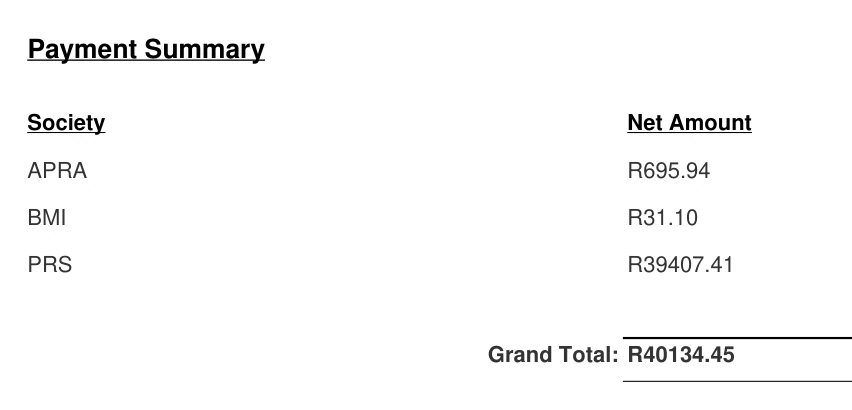
R40,134.45 for that distribution, of which R39,407.41 is identified under PRS. You might look at that and ask, hang on, didn't I say I had moved my international royalties to PRS? Yes, and that is exactly the kind of thing I want a member portal and statement to help me understand.
A line headed PRS on a SAMRO foreign statement means SAMRO reported that amount under the PRS society category. It doesn't by itself establish which usage date, contractual territory, prior period or accounting adjustment caused the remittance. A society name on a statement and the current territorial mandate are not interchangeable pieces of information. I'd need the underlying period and society documentation to reconcile that properly. I don't want to teach someone to make assumptions just because a letterhead says PRS.
The channel information can still be very specific on SAMRO.
Here's another excerpt, from that same September statement. It involves Blue Banger, which I've previously been able to trace on programmes such as The Ranakas and Our Perfect Wedding. In this particular foreign distribution it appears against Sky Sports Golf.
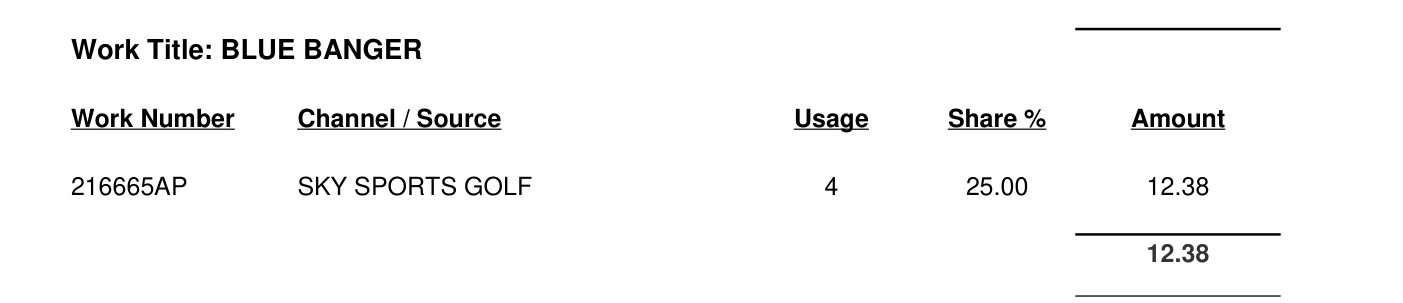
Four usages, a 25% share and R12.38. It's a very small number, yes. But it gives me something to investigate: a track title, broadcaster, number of uses and allocated amount. The line is evidence of reporting in that distribution, not evidence of everything that track has ever earned from Sky Sports or of a sync fee paid upfront.
One of the most interesting entries for me, though, is this one:

Fountain of Youth has a line labelled SoundCloud LTD, with 250 under usage and R34,192.31 as the amount for that row. On the following page of the same statement there's a CNN (SPD) entry for the same work as well. This is why these PDFs are such a useful resource, even if I wish there were more ways to explore the information interactively.
I want to be careful here. That SoundCloud label is what the statement says. I can't take the number 250 and call it 250 public SoundCloud plays, or decide that 250 ordinary streams were worth thirty-four thousand rand. The source label and the usage count need to be understood in the context of that society's distribution data. It's the kind of entry I'd keep and ask a very precise question about rather than guess.
So how do the two online experiences compare?
If I'm looking specifically at what I can do with the records and how easily I can get from a payment to an explanation, these are the differences worth understanding. I have access to my own distributions and I can verify PRS's published descriptions of its member tools. I haven't included a logged-in screen recording of either portal here, so I'm not pretending to have independently audited every button in the latest SAMRO member interface.
| What I'm trying to do | PRS | SAMRO |
|---|---|---|
| See a royalty payment | My Statements and payment notices; expected amount is shown ahead of a main distribution. | Distribution statements and notices for the applicable categories. |
| Investigate a song | My Statements exposes works, detailed usage and territories, with Analytics tools and a separate My Works list. | My PDF statements provide work title, source, usage, share and allocated amount; SAMRO publicly confirms work-notification functionality through its portal. |
| See international reporting | Specific usage and territory descriptions, subject to data received from the relevant society. | Foreign statement groups the incoming society amounts first, followed by work and source lines. |
| Follow up on missing money | PRS provides online case-raising guidance, unpaid-file checks and cue-sheet checks. | SAMRO directs members to its Communication Hub and asks for track, station/programme, date and preferably time; undocumented works can be notified through the portal. |
| Track registrations | My Works and Search Works support registered-repertoire checks and work enquiries. | SAMRO provides work-notification tools; I wouldn't claim feature-for-feature parity without a current member dashboard demonstration. |
| Work with the data | Online drill-down and downloadable statements plus Analytics are explicitly described by PRS. | The statement PDFs contain valuable evidence, but the level of interactive cross-distribution analytics available to a member needs to be checked on the current portal. |
My experience is that PRS gives me a more direct route into asking questions about a distribution. I can think in terms of a work, a territory or a source rather than just a payment date. With SAMRO, the downloaded statements have a lot of information that is worth analysing, but I often end up doing more of the comparing and cross-checking myself, which is part of why I started keeping a master royalty spreadsheet.
I'd also make a distinction between the quality of the interface and the quality of the collections. A beautiful dashboard doesn't make a missing cue sheet appear. It doesn't mean money from a country will arrive faster. If someone is collecting an upfront sync fee, that doesn't mean their performance royalty has been reported. A portal can show you the information an organisation has received, but the entire production-music chain still matters.
What PRS is not going to solve for me automatically.
I have music with quite a few publishers, and some of my tracks have similar names or multiple versions. There are titles that have been earning for years, and other tracks where I know the music has been sent out and I'm still looking for clear usage on a royalty statement. I have also followed up with people about cue sheets that were sent to me, because the usage I'd expected wasn't yet reflected in the statement.
So before accusing either society of missing a payment, I need to know the date of the usage and the reporting window. SAMRO says royalties for a broadcast may typically be distributed about twelve months after the use, depending on category and adjustments. PRS warns that overseas collections can take longer as well. There's a period between something playing and money being available. That period is real.
Then I need to look at ownership. Who wrote the song? Was it registered under the exact same title? Is there an alternate version? Which publisher registered it, and with which writer split? Is the cue sheet actually complete? If those pieces aren't correct, changing organisations won't magically correct them.
The other important thing is rights. I'm talking about performing rights in this article. PRS isn't the same thing as MCPS, which administers mechanical rights for its members. In South Africa, CAPASSO administers mechanicals for its represented works and SAMPRA operates in the neighbouring-rights space. There is more than one right wrapped up in the same song and recording. It's something producers really need to get comfortable with, especially once they start working with sync.
How I'd investigate one missing placement, step by step.
- Write down the usage I believe happened. Track title, alternative title, programme, broadcaster or platform, country, date, approximate duration and whatever evidence I have. A clip or cue sheet is useful.
- Work out which right and territory we're talking about. I check whether SAMRO or PRS is responsible under my agreed arrangement for that territory and time period, instead of assuming the foreign society name on a statement tells the whole story.
- Check the registrations and the reporting window. No money in a recent payment doesn't necessarily mean the usage was lost. I verify titles, writer shares, publisher information and which reporting period should have included it.
- Read the statements at the level of the composition. In PRS I use the work and usage views. In SAMRO I read the category and foreign PDFs, then compare the society, broadcaster and usage lines against what I already know.
- Make a specific enquiry. “My music wasn't paid” is vague. “This composition appeared in this programme on this date and I have the cue sheet; can you confirm its status?” is an enquiry someone can actually work with.
- Keep the reply. I put the paperwork together with the royalty record. If it turns into a supplementary distribution or adjustment a year later, I want to know what it relates to.
Which portal would I rather use?
For digging through work and usage information, I lean towards PRS. I like being able to see more of the breakdown and do something useful with it. The reporting categories, the works and the way the statement presents territories are particularly helpful when you've got music sitting in different libraries and being licensed around the world.
But SAMRO remains part of my system. It handles South African performing-rights representation under my joint arrangement, and the PDFs I've shown here are evidence that its reporting includes some very specific usage and foreign-society information. I still need to review those statements properly. There's no benefit to me in ignoring them because I happen to prefer the other dashboard.
And I don't think the interesting question is simply which organisation has a prettier portal. It's whether I can establish what was played, where it was played, who was supposed to account for it and whether the payment eventually makes sense. I've built enough music at this point that a few hundred rand here and there becomes important in aggregate, and the occasional larger royalty is usually connected to a track that somebody made quite some time ago.
That's something I've learned from watching the catalogue grow. The music being used is only half of the exercise. Understanding the paperwork and finding the money is the other half.
About the evidence and the portal information
The eight images above are unaltered content crops from my own original PRS October/December 2025 PDFs and SAMRO February/September 2026 foreign-distribution PDFs. I've excluded the personal header, membership numbers, postal address and contact details; I have not rewritten the figures in the images. Different currencies, distribution dates, rights territories and reporting categories mean these are examples of statement presentation, not a like-for-like financial comparison.
Official material I checked for how the systems work: PRS: My Statements and Analytics; PRS: My Works; PRS: missing royalties and cases; PRS: territorial membership; SAMRO: distributions and undocumented works; and SAMRO: member support and foreign partners. Member interfaces and distribution rules can change, so this is dated October 2026.