
A placement is exciting, obviously. You hear your music somewhere it wasn't before, or someone sends you a clip of a programme and says, that's your track. Great. But then comes the part that isn't quite as entertaining. You have to figure out where the usage was reported, what rights it relates to, when that usage is actually likely to show up and which organisation pays it.
I've had royalties arrive long after the original work was made. So when I look at a statement now, I'm interested in more than the total at the bottom. I look at titles, broadcasters, territories, usage counts, shares and whether the line actually matches what I expected.
Here's one real example from my statements.
I went back to a SAMRO foreign-royalty distribution dated 9 September 2026. That distribution includes payments reported from PRS, APRA and BMI. The total was R40,134.45. That is one distribution, not my total sync income and definitely not a promise that another producer can expect the same result.
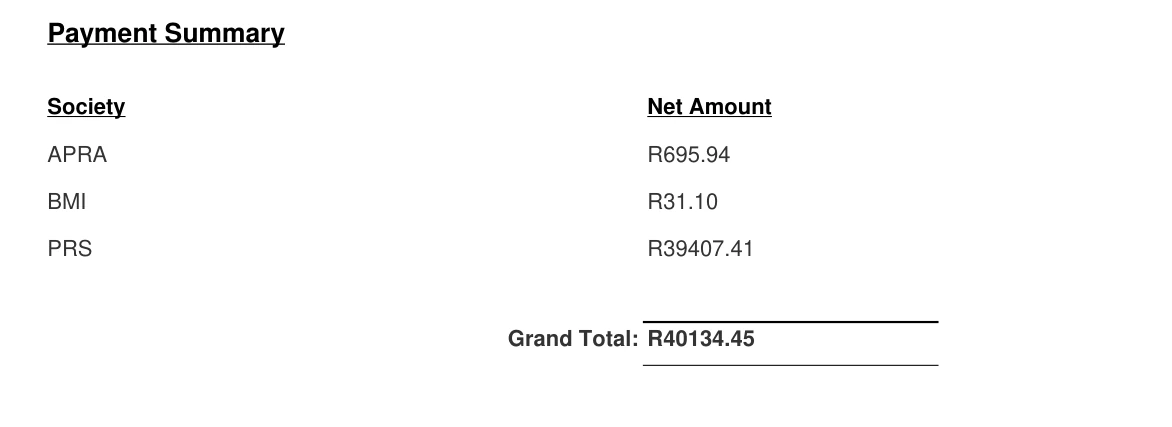
This is the part I wish more musicians got to see. Not a screenshot of somebody's bank balance with the caption telling you that sync is easy. A statement. It tells a more useful story. That distribution was R40,134.45, but look at how unevenly it was made up: PRS contributed R39,407.41, while APRA and BMI contributed smaller amounts. If I only showed the grand total, you might imagine all those collecting societies paying similar amounts. They didn't.
And I don't look at the societies as competing sources of income. The organisations are collecting royalties under their respective arrangements, in different territories, on uses that have been reported and processed. A statement landing in September doesn't mean every play on it happened in September, either. The reporting and distribution lag is an entire part of this business.
One page, completely different kinds of usage
The next screenshot is another part of that same PDF. You can see Be Easy listed against Sky Sports NFL, with 109 reported uses and R70.81. A few rows later, Behind Closed Doors shows Netflix, 45 uses and R359.59. That's a useful little reality check. A bigger usage count doesn't automatically mean a bigger royalty payment. Different reporting sources, royalty distributions, territories and rightsholder shares all matter.
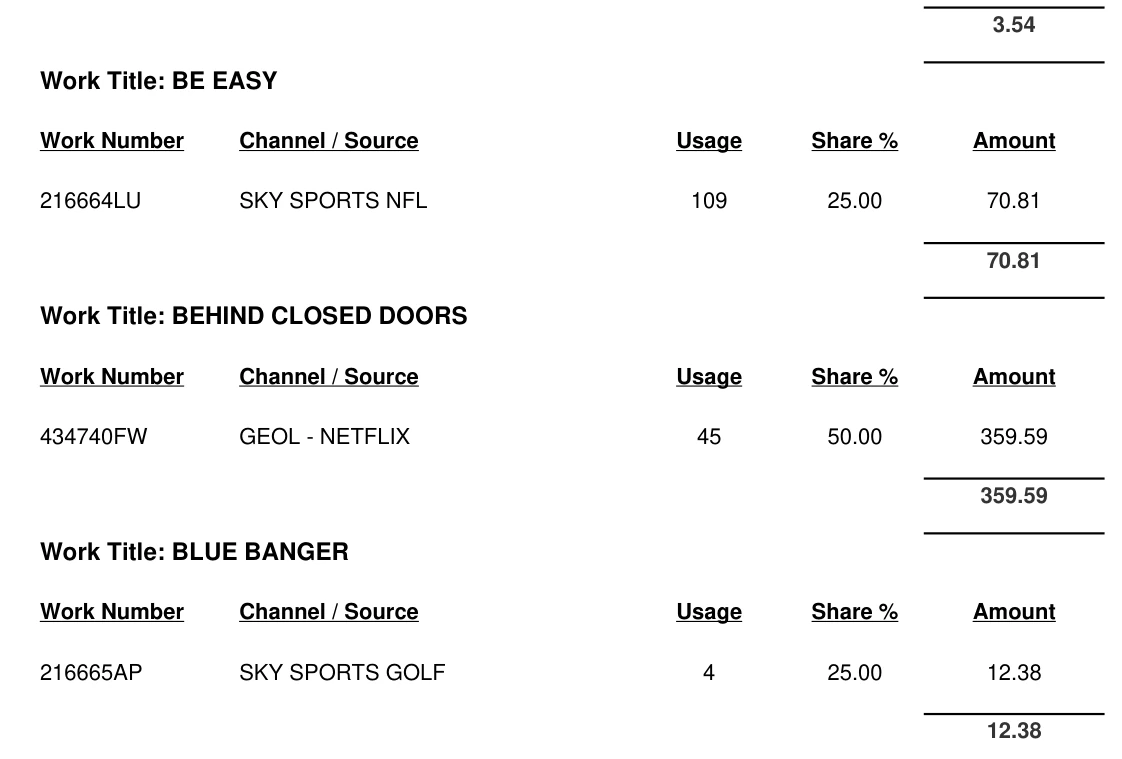
Now, the fact that a source is named here is evidence that a reported use made its way through to this distribution. It doesn't give me the underlying licensing agreement. I can't look at a Netflix line and tell you what the sync fee was, what the publisher negotiated or what everybody else was paid. Those are different questions. You need the right documents to answer them.
Look at Fountain of Youth. This is why I study the lines.
There is a track in this statement that makes the difference even clearer. Fountain of Youth appears with a substantial SoundCloud reporting line on page 5, and then a separate CNN line on the following page. Here are those actual sections from the PDF.
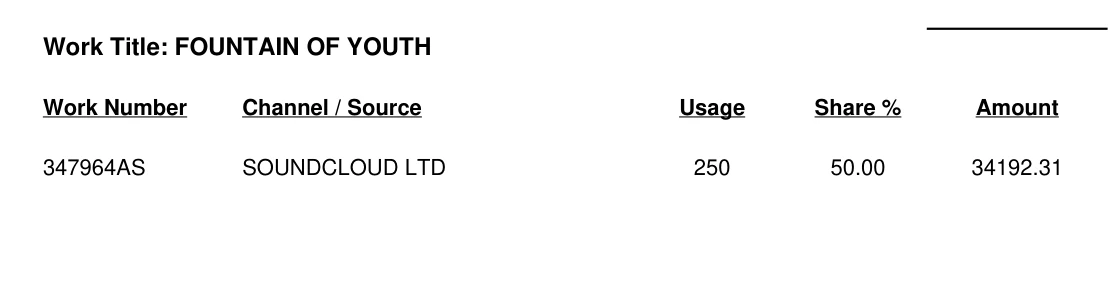

What matters to me here is not just that one of those lines is large. It's that I can recognise a work I've spent time on, find it under more than one reporting source and start comparing it to the rest of my catalogue. Some tracks have generated only a few cents in distributions. Others carry real weight. When you start studying it that way, the question moves from How many tracks have I written? to Which tracks are actually being used, where, and how do I build more music with that potential?
That is also why I don't throw away the small lines. A few cents can tell you a work has been identified and reported in a place you weren't even thinking about. It might not be much money, but it is information. I can combine that with cue sheets, publisher updates and later statements to see a pattern. Or to notice when I expected a usage and can't find one.
For anybody looking at sync as an income stream, keep those two conversations separate: the money earned from licensing a recording or composition for a production and the downstream performance or other royalties that may appear later. They don't necessarily arrive together, they aren't always administered by the same organisations, and one statement doesn't tell the entire commercial story.
What this changed for me
The interesting bit is how uneven this business can be. One track works harder than a whole batch of other tracks. Some uses generate very little. Others keep appearing in statements months and years later. A catalogue isn't automatically a profitable catalogue just because the track count gets big.
And that's why I keep track of what earns, what gets used and what doesn't. It's also why I spend time learning how registration, publishing, mechanicals and performance royalties fit together. A song can be on television and there can still be information missing or a payment that takes time to reach you.
If you're beginning, my advice is to get the boring admin right early. You can experiment with the music as much as you want. I certainly do. But you don't want your paperwork to become the thing that trips you up years after the music finally lands somewhere.
Want to sort your own registrations?
I have a free South African music-registration guide and a more detailed toolkit if you need it.
Start with the free guide ↗Editorial note: The accompanying video is embedded from my channel. This written article is an edited companion piece informed by my real royalty records, not a verbatim transcript. The screenshots above are genuine excerpts from an original PDF. The personal header and contact details have been excluded; no amounts, reporting sources or usage counts were altered.