
For a long time, the total was the most interesting part of a royalty statement.
I wanted to know what had come in. If it was a decent amount, I was happy. If it was small, I wondered what had happened to all the music I’d been making.
As I spent more time going through the statements, I started paying attention to the information underneath those totals.
There were societies I recognised, broadcasters I hadn’t expected, and programmes I could actually go and watch. Some tracks appeared repeatedly. Others had been sitting in my catalogue for years without showing much activity.
I’d spent hours making that music. The statements gave me a way to find out what had happened to it afterwards.
Eventually, they also helped me think about what to make next.
The first clues were on the first page
One of the useful things about my SAMRO foreign statements was the society breakdown at the beginning.
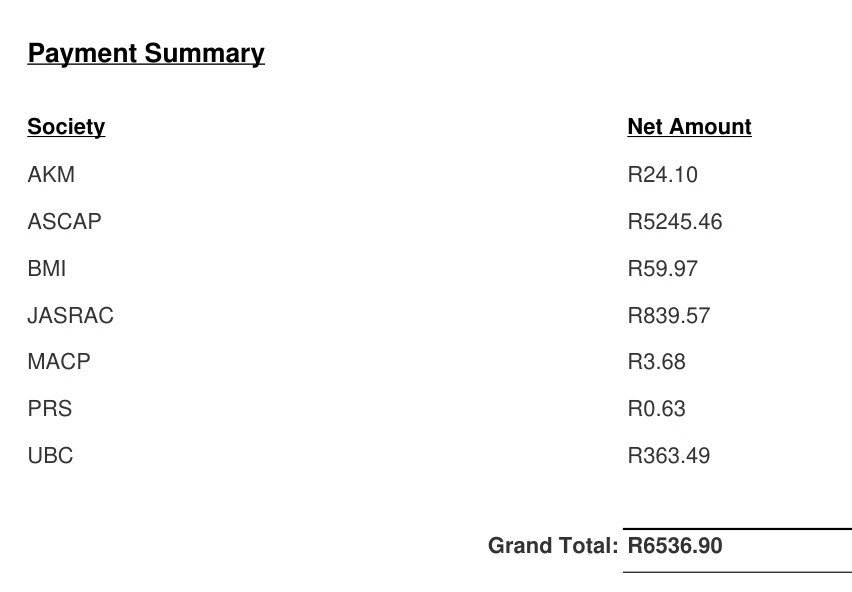
My February 2026 statement showed this:
 Tap to enlarge the original extract ↗
Read key figures as text
| ASCAP | R5,245.46 |
|---|---|
| JASRAC | R839.57 |
| Grand total | R6,536.90 |
The total was R6,536.90, with R5,245.46 listed under ASCAP and R839.57 under JASRAC. Smaller amounts appeared under several other societies.
That gave me somewhere to start looking.
Which tracks had contributed to those amounts? What territories and uses appeared further into the statement? Had the same sources appeared before?
The society names were useful clues, although I still needed the underlying detail to understand where the music had been used. The society that supplied the money and the territory of a particular use weren’t necessarily the same thing.
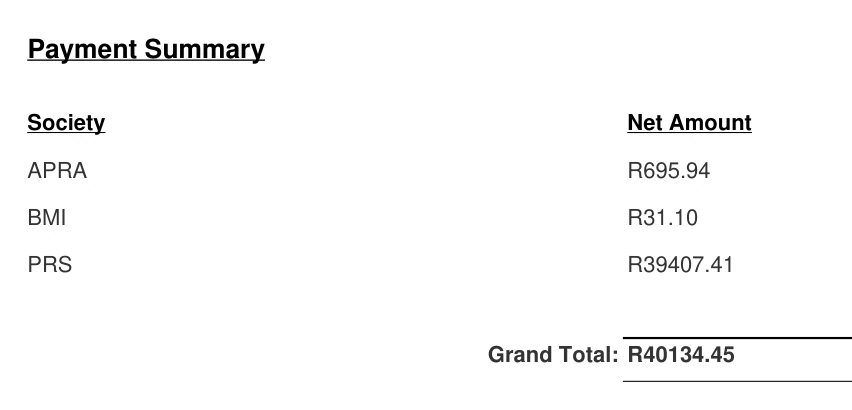
By September, the breakdown looked very different:
 Tap to enlarge the original extract ↗
Read key figures as text
| APRA | R695.94 |
|---|---|
| BMI | R31.10 |
| PRS | R39,407.41 |
| Grand total | R40,134.45 |
That PRS line immediately caught my attention.
It was a substantial amount, but the summary hadn’t explained which tracks had earned it or which reporting periods were involved. I had to keep reading.
Those first pages had started giving me questions I could follow through the rest of the statement.
The broadcaster names made it more specific
When I looked back through my PRS statements, I found descriptions that helped narrow things down further.
Here was part of the October 2025 usage summary:
 Tap to enlarge the original extract ↗
Read key figures as text
| CNN (NSPD) | £369.88 |
|---|---|
| CNN (SPD) | £134.61 |
| CNN – KODA (NSPD), covering Denmark | £119.13 |
There were separate entries for CNN (NSPD) and CNN (SPD). Another line read “CNN – KODA (NSPD) covering Denmark.”
Now I had more detail than a general heading saying “foreign.”
I could see a broadcaster and an explicitly named territory-related reporting route. From there, I could check the individual works that contributed.
My track Fountain of Youth had been used on CNN Inside Africa, so CNN was a name I already had a reason to investigate. But I still had to reconcile the work-detail entries before deciding how much of a particular CNN category belonged to that track.
As I compared statements, I started getting a clearer picture of which broadcasters and territories were appearing around my music.
Then the statements gave me shows to look up
The programme names were particularly useful.
In my May 2026 SAMRO television statement, Grand Finale appeared against both The Real Housewives of Cape Town and The Real Housewives of Durban:
 Tap to enlarge the original extract ↗
Read key figures as text
| The Real Housewives of Cape Town | R0.61 |
|---|---|
| The Real Housewives of Durban | R2.25 |
| Work subtotal in this statement | R2.86 |
The amounts in that extract were small. The programme names still gave me something useful.
I had a composition I knew and two shows I could look up. That was a much more specific starting point than wondering whether anybody was using the music.
Further down the same page, Blue Banger appeared repeatedly against Diski Challenge and Diski Challenge Build Up:
 Tap to enlarge the original extract ↗
Read key figures as text
| Diski Challenge · first selected row | R15.92 |
|---|---|
| Diski Challenge Build Up · first selected row | R8.22 |
| Diski Challenge · second selected row | R17.93 |
| Diski Challenge Build Up · second selected row | R8.56 |
Seeing those repeated programme names made me pay attention.
I could begin separating a track that had appeared occasionally from one that had found repeated use in a particular type of programming. I could also start thinking about the sort of production that needed it.
A reality programme and football coverage had different demands. Having actual titles gave me a way to study those differences.
Watching the programmes gave me more to work with
Once I had those names, I could go back and watch the shows.
Finding the exact episode or moment wasn’t always straightforward. Even so, watching the programme gave me a better understanding of the music around it.
I started listening to the other tracks as carefully as I listened for my own.
What were the drums doing? How busy was the bass? How much melody could sit underneath the dialogue before it became distracting? Where had the editor needed a change, a pause or an ending?
I could hear how a track had been used within a finished programme, rather than judging it entirely from the studio session.
That gave me ideas for arrangements, sounds and alternate versions. I could try to work out how another producer had created a particular feeling, then experiment with those production choices in my own work.
The point was to understand the sound and its purpose. I still needed to write my own music.
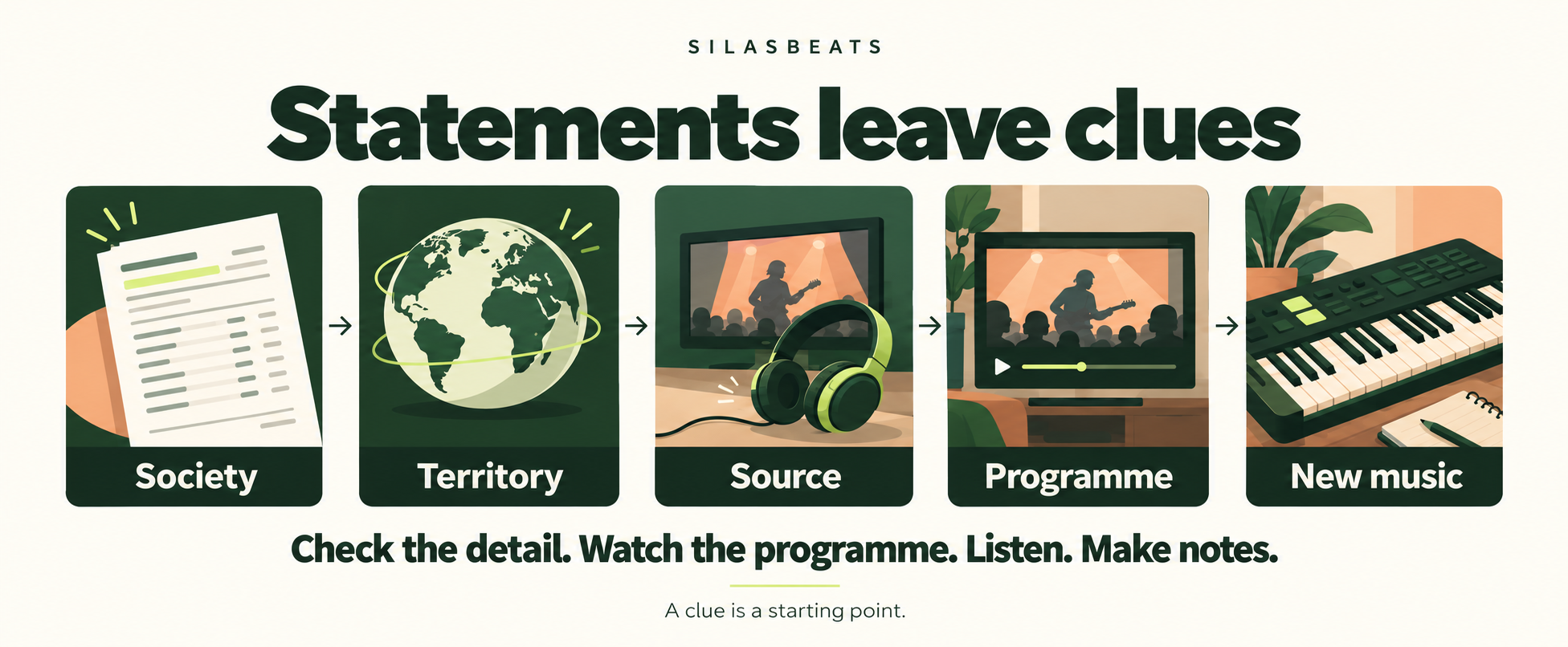 Enlarge the illustration ↗
I had to separate the show from the way it was watched
The source descriptions also made me more careful about what I thought I’d discovered.
A programme could have been broadcast on television and made available through a streaming service. Knowing the show’s name didn’t automatically tell me which use a royalty entry covered.
I needed to check the broadcaster or platform, the distribution category, the territory and the reporting period.
That mattered when trying to distinguish television from Netflix, radio from streaming, or one broadcaster from another. A show being available on Netflix didn’t establish that a particular payment came from Netflix.
SAMRO separated television, radio and internet-related reporting into different categories, while foreign distributions could include different types of use. I had to read the detail rather than stop at the category heading.
SAMRO’s explanation of its distribution categories ↗
One entry in my September 2026 foreign statement made that need for care particularly clear:
 Tap to enlarge the original extract ↗
Read key figures as text
| Reported usages | 250 |
|---|---|
| Share | 50% |
| Allocated amount | R34,192.31 |
That was a large figure beside a familiar name.
It would have been easy to turn it into a simple story about uploading music to SoundCloud. But the row hadn’t explained the underlying use in enough detail to support that conclusion. I couldn’t treat “250 usages” as 250 ordinary public plays or assume this was a normal streaming payout.
It was a strong reason to investigate the reporting behind that label.
Some clues had answered questions. Others had shown me which questions I needed to ask.
The biggest figures deserved attention too
Of course, I looked closely at the tracks that earned the most.
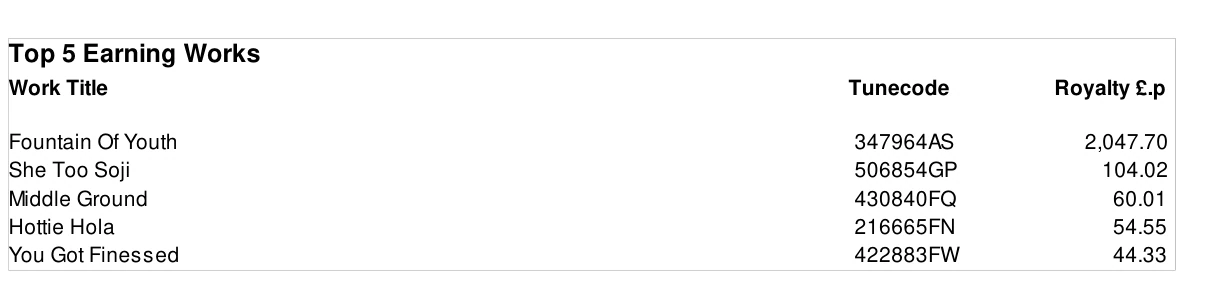
In the top-five works table from my October 2025 PRS statement, Fountain of Youth was listed at £613.96. In December, it appeared at £2,047.70:
 Tap to enlarge the original extract ↗
Read key figures as text
| Fountain of Youth | £2,047.70 |
|---|---|
| She Too Soji | £104.02 |
| Middle Ground | £60.01 |
| Hottie Hola | £54.55 |
| You Got Finessed | £44.33 |
The difference was substantial. So was the gap between Fountain of Youth and the other works in that December table.
I couldn’t sensibly take that result and assume every similar track would earn the same amount. There could have been an unusual combination of uses, territories, reporting periods or adjustments behind it.
The largest figures could have been unicorns.
But I didn’t think that made them something to ignore. A track that had earned well gave me a good reason to look closely at its sound, its uses and the relationships that had helped place it.
If I found related tracks appearing repeatedly, that was more useful still.
Had a certain mood worked across several programmes? Had one library been getting results with a particular group of tracks? Was there enough repeated use to justify making another album in that area?
Those were decisions I could begin supporting with actual information.
The statements started affecting my studio plans
The more I looked, the more those details connected.
A society summary pointed me towards money that needed explaining. The work detail showed a broadcaster or programme. The programme gave me something to watch. Listening to the music gave me ideas I could take back into production.
The amounts helped me decide which examples deserved a closer look.
I still wanted to make music I enjoyed. I also wanted to understand which parts of my catalogue had found a use and whether I could build on that.
By then, I’d started treating statement-reading as part of the work.
I paid more attention to repeated titles, kept track of the programmes, and looked for patterns across more than one distribution. When something didn’t make sense, I had a track name, source or period to ask a society or publisher about.
I’d opened those documents to find out how much I’d been paid.
I’d ended up with shows to watch, sounds to study and a few better ideas about the next tracks I wanted to make.
The statement extracts came from my own SAMRO and PRS distributions. Personal membership and contact details have been excluded. The dates and currencies refer to separate distributions; the figures haven’t been combined into a single period.