 SILASBEATS LEARNING
How a R7 royalty statement differs from a R40,000 statement
I got a SAMRO statement recently for R7.22. Seven rand and twenty-two cents. I actually laughed when I opened it, because I also have statements from the same catalogue for R26,000 and R40,000. I thought it might be useful to put them next to each other. I spend quite a bit of time looking through royalty statements and I've noticed that people tend to talk about royalties as though there's a reasonably predictable amount you're supposed to receive once your music is being used. My experience hasn't really looked like that.
Part of the confusion is that a statement isn't a report card on your entire catalogue. It's a report of particular usages processed for a particular distribution. The category matters enormously. So does where the music was used, when it was used, what data reached the society, and which tracks happened to earn that time. I'm going to use three actual statements here rather than the usual made-up example.
The seven-rand statement
Here's the one that got me thinking about this. The statement is labelled FY2027 Post Sequence 1, dated 8 October 2026. Its four payment lines are R4.13, R0.80, R1.41 and R0.88. Together that's R7.22.
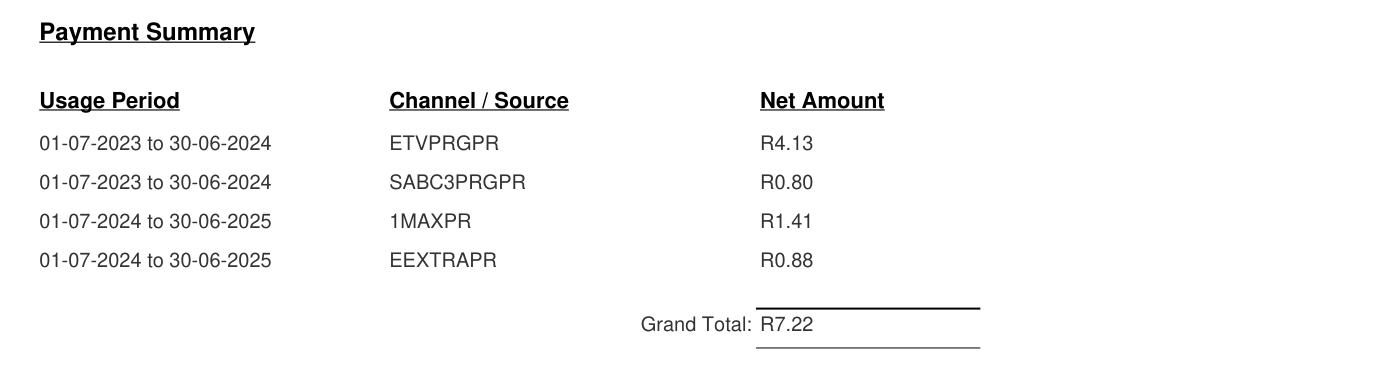
Now, the interesting part is that these are not imaginary usages. The detailed statement names programmes and tracks. Dwelling appears against Wifey Material. Popping Off has two entries for The Masked Singer SA. Africa Rising has an entry for Scandal, and another one for 016 FM. There's music being recognised here. The amount just happens to be very small.
I don't particularly expect these smaller post-distributions to do much for my finances. I still want the reporting to be correct, obviously, but it would be quite odd to use this R7 statement as my benchmark for what the catalogue earns. I've seen people get frustrated because their music has been broadcast and the money that eventually arrives bears very little resemblance to what they imagined a broadcast was worth. This is one example of why I don't attach a fixed monetary value to the word 'placement' by itself.
What a television distribution looks like
Here's another statement. FY2026 TV Sequence 2, distributed on 29 May 2026, came to R26,570.85.
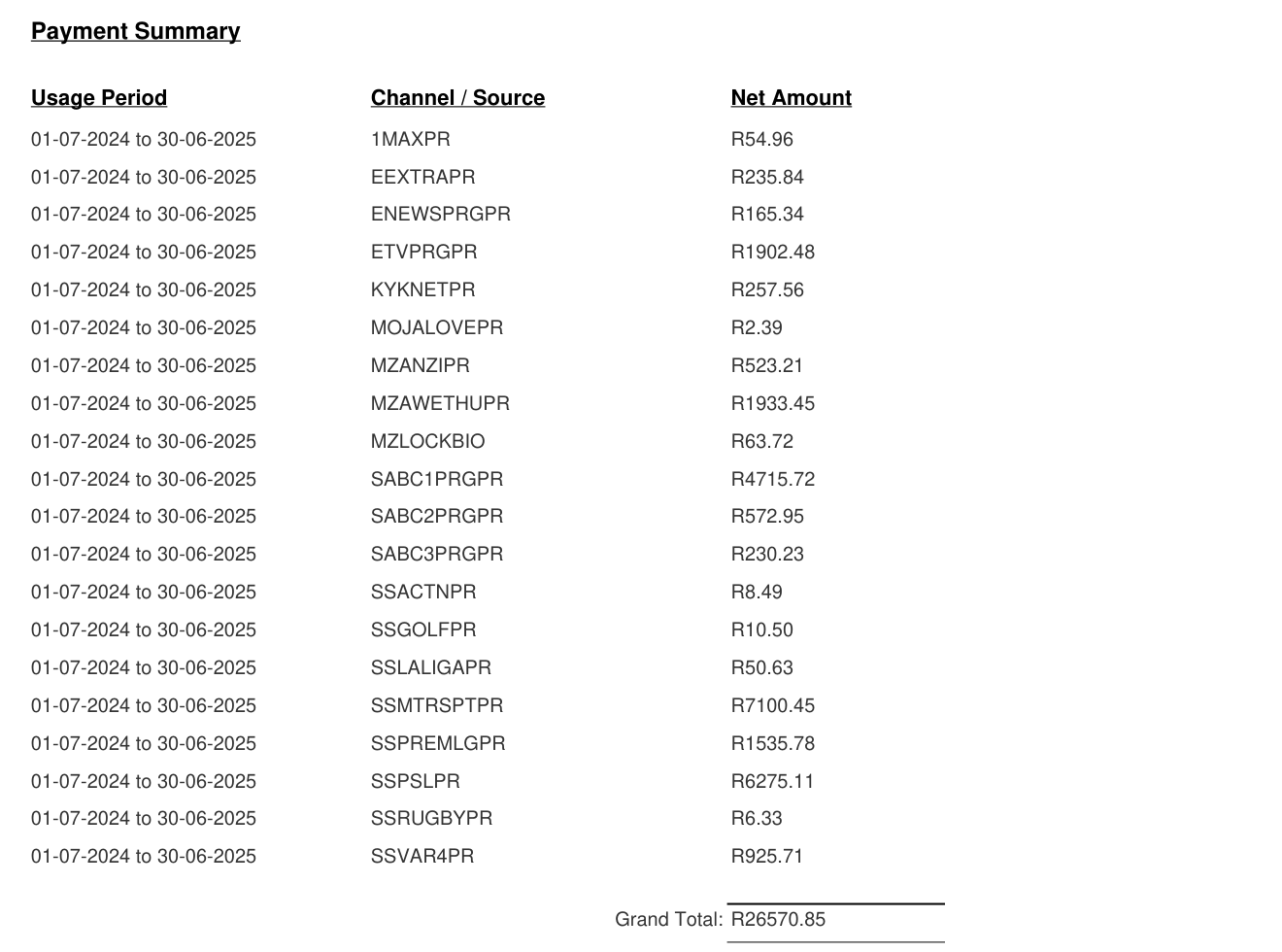
When I go through the pages, I can see why it's different. Blue Banger earned R5,013.40 in this distribution, much of it linked to Diski Challenge. Roll Up earned R2,238.05. There are other tracks across football coverage, lifestyle programming, drama and factual programmes. It isn't simply that one television play pays R26,000. We're looking at a collection of reported usages across tracks and channels, with different rates and shares.
One thing I've learned from my own statements is that a track can be doing well on a particular programme for quite a long time without me paying much attention to it. Then the statement arrives and I start seeing patterns. That's actually one of the reasons I've spent so much time building the royalty master sheet. I want to know whether the music is being used repeatedly, which titles are working, which publishers are producing results, and whether the newer tracks are beginning to show up. The total amount is useful, but the detail is usually more interesting to me.
Television sequencing is one of the categories I take seriously when I'm thinking about potential royalty income. That's based on years of seeing how my catalogue performs. Somebody writing mainly radio hits would have a very different set of expectations.
Then there's the foreign statement
The third statement is FY2027 Foreign Sequence 1, distributed on 9 September 2026. R40,134.45. The first page breaks it down into APRA at R695.94, BMI at R31.10 and PRS at R39,407.41.
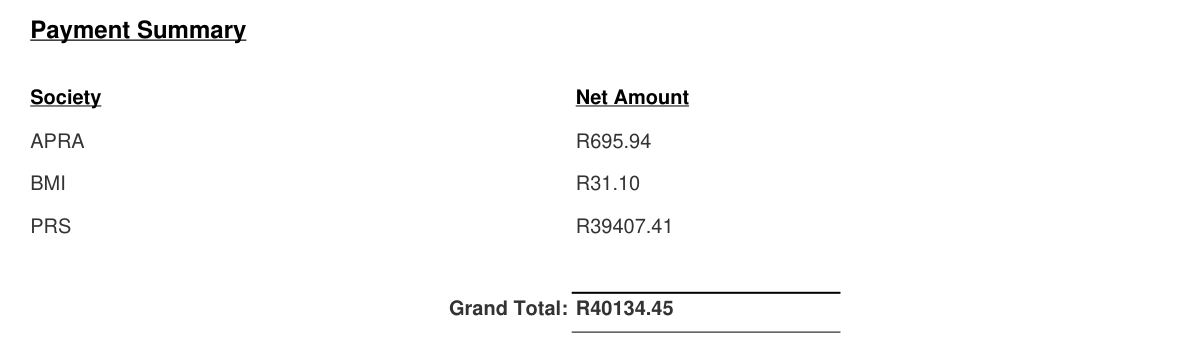
There's something worth noticing when you go beyond that first page. Fountain of Youth accounts for R35,309.92 of the statement on its own. The detailed entries include R34,192.31 against SoundCloud and R1,117.61 against CNN. It's by far the biggest contributor here.
That changes how I read the R40,000. If I simply told someone that my catalogue earned forty thousand rand from a foreign distribution, they might imagine hundreds of tracks all quietly contributing to a nice average. In reality, one track is carrying a huge portion of that payment. I've had hundreds of tracks sitting in the catalogue without ever showing an earning. A handful have done some serious lifting. Both things can be true when you're building this kind of business, and I've found that the big numbers can hide quite a lot of inactivity underneath.
I still get excited when I see a substantial foreign statement, particularly because a good portion of my music was written specifically for international production libraries. But I also know that the next distribution could look nothing like it. The society, the territory, the timing of a usage and the reporting all affect the result.
How I think about an expected royalty payment
At this stage, I don't really plan my year by taking whatever royalties I earned last year and dividing them neatly by twelve. That doesn't reflect the way these distributions arrive. I work with SAMRO's distribution schedule and I pay attention to the categories that have historically been meaningful for my catalogue. Foreign and TV sequencing are the two that get most of my attention. For Radio & General, my expectation is usually low, sometimes practically nothing. That's not because radio doesn't pay musicians. It's because I'm looking at my own music, my own usage history and the ways it's most often licensed.
Even with those expectations, I still regard the bigger distributions as variable income. If I need to make a business decision based on royalties that haven't arrived yet, I want to know how much of the forecast is supported by actual past statements. I might have a track that has suddenly started earning well, but I don't assume it will repeat the same amount every sequence. Some of the money in this business has a very long tail, and some of it is a rather unexpected spike.
The calendar makes a difference
Another thing that confuses people is the timing. SAMRO's financial year runs from July to June, but the royalty categories aren't all paid in the same month. This is the abbreviated FY2027 schedule. I think it's useful to look at something like this before deciding whether you're having a good or bad royalty month.
| Distribution | Scheduled months in FY2027 |
|---|---|
| Foreign | Sep 2026 · Feb 2027 · Jun 2027 |
| Television | Dec 2026 · May 2027 |
| Radio & General | Dec 2026 · May 2027 |
| Mobile & Internet Transmission | Sep 2026 · Dec 2026 · Apr 2027 · Jun 2027 |
| Post | Sep 2026 · Mar 2027 · Jun 2027 |
Source: SAMRO distribution schedule. Refer to the official schedule for updates. The months are not a guarantee of an individual payment.
The dates of the underlying usages are another matter. Music might have been broadcast many months before it turns up in a distribution. There's the time taken to receive and process usage data, among other things. I've had newer compositions take a good while to begin appearing in royalty statements, so I try not to read too much into their absence early on. It can mean something is wrong, but it can also mean the reporting hasn't caught up with the usage yet. You have to investigate before you decide.
And then there's the wait for the statement itself
This is one of my small frustrations with reconciling SAMRO payments. The money can reach my bank account and the supporting statement only becomes available to me about two or three weeks later. So I know I've been paid, but I'm still waiting to see exactly which tracks contributed. In the meantime I've got a figure sitting in my accounts and very little context for it. That's been my experience, rather than an official timeline that applies to everyone.
PRS has generally been different for me. When I get the payment, I can usually get into the statement on the same day and begin checking the titles. It's much easier to connect the money to the music while the transaction is fresh. I've been meaning to write more about that because the way you actually work with these portals becomes quite important once the catalogue has grown beyond a few dozen tracks.
So when I look at those three statements together, I'm not really seeing R7 versus R40,000 as a judgement on the quality of the compositions. I'm seeing different distribution streams, different programmes and territories, different usage histories, and a catalogue where revenue isn't spread evenly. Understanding that has helped me set my expectations without becoming indifferent to the small statements or assuming the big ones will keep arriving at the same level.
These are real, privacy-redacted excerpts of my statements for specific distributions, not typical earnings or projected returns. This article reflects my catalogue and experience, not legal, tax or financial advice.